Insights · Visayas
Maria Cacao of Mount Lantoy: A Cebuano Legend Traced Through Two Scholarly Studies
On Mount Lantoy, a mountain in the interior of Argao, a municipality in Cebu, local tradition places the home of a diwata named Maria Cacao. She is said to live in a cave on the mountain. Cacao trees growing outside the cave are described as her plantation, and when rain swells the rivers below, she is said to float down to the coastal towns in a golden ship to sell her goods, according to the geographic entry on Mount Lantoy. The signature image across nearly every recorded version is this golden boat striking, or collapsing, a bridge as it passes during a flood — the sound and the damage are what tell villagers she has sailed again.
What the record actually agrees on
The most careful account of this legend comes from Erlinda Kintanar Alburo, a researcher then with the University of San Carlos in Cebu City, whose 1980 study in the Philippine Quarterly of Culture and Society examined twenty-one versions of two related Cebuano legends — "The Lost Lender" and "The Legend of Maria Cacao" — as confirmed by the journal listing held by the UP Baguio Library Serials Section and by a summary of the study itself, which states plainly that "this study analyzes 21 versions of two Cebuano legends from the Philippines" (scribd.com/document/396916251/Cebuano-legends).
Looking specifically at the seven versions that concern Maria Cacao, Alburo identified a short list of constants that hold across nearly every telling: "the Mysterious Maria Cacao, her dwelling place, the cacao trade, the boat and bridge, and the disappearing act," as summarized from her study by a student-researcher page hosting notes on the work (sites.google.com/dlsu.edu.ph/mariacacao/other-media). In other words, the figure herself, her cave, her trade in cacao, the golden boat that breaks a bridge, and her habit of vanishing from view are treated as the stable core of the legend. Everything else — her exact origin town, her companions, her trade destination — varies between informants.
A male figure usually named Mangao, sometimes spelled Mangaw, appears in several variants as a husband or business partner who sails or trades alongside her. He does not appear on Alburo's list of five constants; this absence is worth noting as a gap in what counted as the stable core of the story, rather than as proof either way about how common he is across tellings.
Argao or Dalaguete: an unsettled origin
One detail folklore researchers have not resolved is exactly which town the legend belongs to first. Alburo's study treats this as a genuinely open question rather than a simple fact: notes drawn from her analysis record that "the boat motif may originate from Dalaguete or Argao, Cebu," and raise the possibility that "Maria Cacao may be a Dalaguetnon figure rather than purely an Argao one" (sites.google.com/dlsu.edu.ph/mariacacao/other-media). Argao and Dalaguete are neighboring municipalities in Cebu, and the fact that a scholarly study leaves the point unsettled is itself worth stating plainly, rather than picking one town and presenting it as settled fact.
A second strand: the Lost Lender
Alburo's 1980 study actually covers two legends, not one. "The Lost Lender" is an older Cebuano tale about a lending figure, sometimes described as an agta or giant, who lends villagers chinaware, utensils, or festive clothing — a practice that stops once borrowers fail to return what they took. In some tellings this lending figure and Maria Cacao's story have merged into a single narrative, with Mangao identified as the agta of the lending tale. But the notes drawn from Alburo's work are careful to frame this as an interpretive judgment about a specific informant, not a confirmed identity: the suggestion is that "the informant had confused and combined the two separate motifs in one tale, since it's common in Argao" (sites.google.com/dlsu.edu.ph/mariacacao/other-media). That is a conclusion about how one storyteller's memory worked, not a claim that the two legends were always one.
Seki's reframing: a story that migrated with people
Two decades after Alburo, Koki Seki published "Rethinking Maria Cacao: Legend-Making in the Visayan Context" in Philippine Studies: Historical and Ethnographic Viewpoints, the peer-reviewed quarterly published by Ateneo de Manila University (vol. 49, no. 4, 2001), archived with its full citation at archium.ateneo.edu. The journal itself is described on its own reference entry as covering "research on the history and ethnography of the Philippines and its peoples" (Philippine Studies (journal)).
Where Alburo mapped how the legend's motifs varied between informants inside Cebu, Seki's fieldwork looked at Cebuano migrants who carried the story with them when they left Argao and the surrounding area. A secondary summary of his argument states that the legend "may have more to do with migratory experiences of the local people, rather than anything directly related to the name" of the place itself (aswangproject.com/diwata) — this should be read as a paraphrase of Seki's conclusion, since his original wording was not available for direct quotation here. The implication worth keeping is methodological: a legend tied to one mountain can still change shape as the people who tell it move away from that mountain, which is a different kind of evidence than simply counting variants collected in one place.
A living variant: the boat that gathers the drowned
The legend has kept changing since Alburo and Seki wrote. An opinion column in the Philippine Daily Inquirer recounts a university instructor's secondhand account of a story circulating after Typhoon Sendong struck the southern Philippines: "after Sendong, there were sightings of a boat floating down rivers and picking up passengers," piloted by a woman identified as Maria Cacao, "said to be collecting souls for the next world" (opinion.inquirer.net/94297/maria-cacao). This is informally collected oral testimony from a classroom retelling, not a folklore survey, and it should be read as exactly that — a recent, disaster-linked mutation of the golden-boat image, recorded after 2011, not a feature of the older recorded tradition.
How most readers meet her today
For many readers, the first encounter with Maria Cacao is not an oral telling at all but Rene O. Villanueva's bilingual picture book, Maria Cacao, Ang Diwata ng Cebu / Maria Cacao, the Fairy of Cebu (Manila: Lampara Publishing House, 2002), translated into English by Grace M. Leung and digitized at the Internet Archive. Its summary keeps the bridge image at the center of the plot: "Maria Cacao is a fairy who lives in Lantoy Cave, and when people see a damaged bridge in Argao, they know that she has set sail in her golden boat and the mast has hit the bridge" (archive.org/details/mariacacaoangdiw0000vill). It is worth naming this book plainly as authored children's literature from 2002, distinct from the field-collected variants Alburo and Seki worked with decades apart.
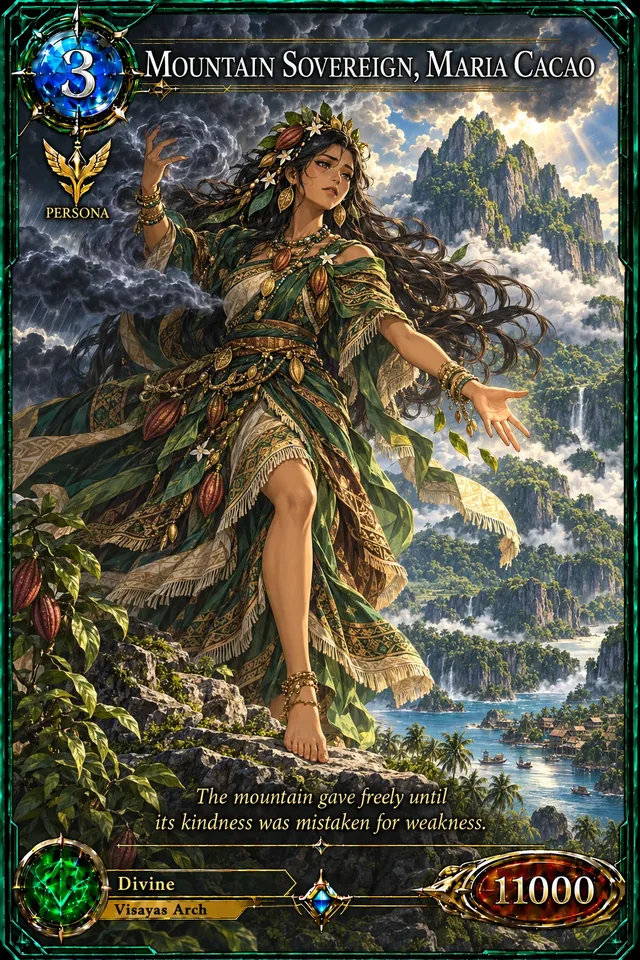
The Maria Cacao card pictured here is a modern artistic interpretation built for play, not a record of any particular oral version. Her cave, her cacao plantation, and her golden boat striking a bridge in flood season remain the parts of the story that recorded Cebuano tellings hold in common — everything drawn beyond that is the artist's choice, not evidence about the legend itself.
Questions people ask about this story
- Is Maria Cacao a goddess or a local spirit?
- The sources call her a diwata. The Wikipedia entry on Mount Lantoy describes her as a diwata living in a cave on the mountain who owns the cacao plantation outside it, and Rene Villanueva's 2002 bilingual book translates the term in its own title as 'the fairy of Cebu' rather than treating her as a creator god.
- Did Spanish colonizers really rename an older goddess "Maria Cacao"?
- That claim appears online, but it is an unsourced inference, not a documented fact. The Wikipedia article on Maria Cacao itself flags the claim as uncited, and no peer-reviewed study in this record confirms an original pre-Hispanic name.
- Is the boat story the same as the story about lending villagers dishes?
- Not necessarily. Erlinda Alburo's 1980 study treats the lending tale and the boat tale as two originally separate Cebuano legends that some informants combined into one story, not as a single settled myth.
- Does the legend still change today?
- Yes. A documented post-2011 variant, recorded as informal oral testimony after Typhoon Sendong, recasts Maria Cacao's boat as a vessel that collects the drowned rather than cacao for trade.
Erlinda Kintanar Alburo (1980, University of San Carlos) and Koki Seki (2001, Philippine Studies) are the two peer-reviewed folklore studies behind this account; web retellings and a 2002 children's book are flagged separately as literary, not field, sources. Read the source.