Insights · Visayas
Two Creations, One Name: Kaptan and Maguayan in the Visayan Record
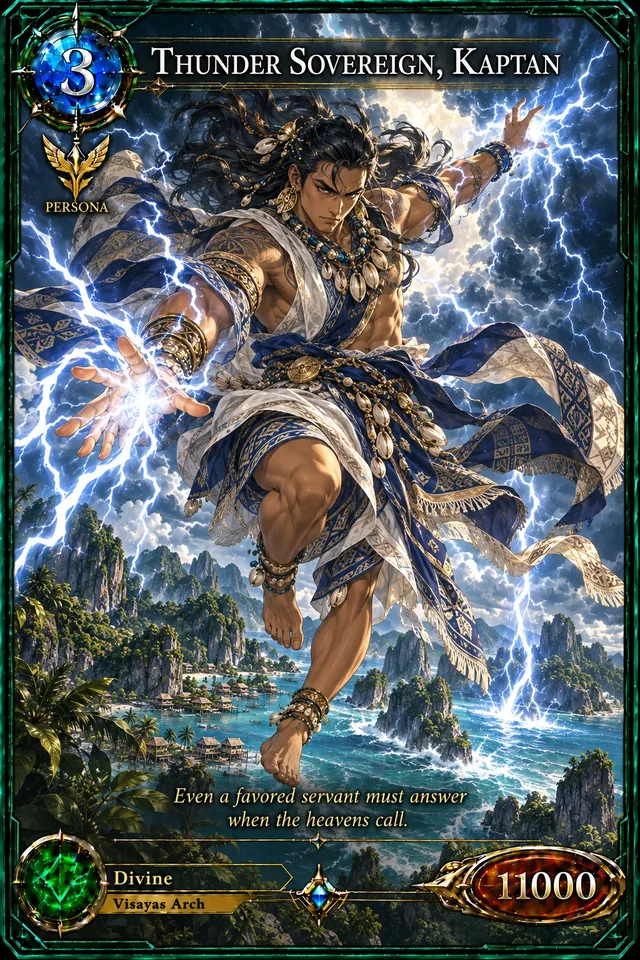
A card showing a bearded figure wreathed in storm clouds, paired with another standing over dark water: Kaptan and Maguayan, read together, look like a single settled myth about sky and sea. They are not. They are two separately recorded stories, written down more than three hundred years apart, that disagree with each other on who these gods are, how they are related, and even what sex they are. Reading them side by side, rather than as one smoothed-over legend, is the more honest way to meet this material.
The earliest written version: Loarca, 1582
The oldest surviving account comes from Miguel de Loarca, a Spanish encomendero who wrote a description of the Yligueynes, coastal people of Panay also called Pintados, as part of his Relación de las Islas Filipinas. His report survives in English translation inside Emma Helen Blair and James Alexander Robertson's documentary collection, The Philippine Islands, 1493-1898, Volume V, where Loarca's 1582 text is reproduced in full (Gutenberg #16501).
In Loarca's account, heaven and earth have no beginning. Two gods, Captan and Maguayen, preside over this state of things. The land breeze and the sea breeze marry and produce a reed, which Captan plants. The reed splits open, and from the two halves come the first man, Sicalac, and the first woman, Sicavay. A younger figure named Pandaguan later invents the fishing net and catches a shark. When he mourns the shark with funeral rites he had not earned the right to perform, Captan strikes him dead with a thunderbolt. Classroom excerpts of this passage add that Pandaguan's death lasts roughly thirty days before he is restored, though the point to hold onto is simpler: in this 1582 telling, Captan and Maguayen are not a married couple, they have no children named in the text, and the first humans are born from a reed produced by the breezes, not from the gods themselves.
The version most readers meet today: Miller 1904, reprinted by Cole 1916
A different and much more widely circulated narrative was first set down in English by John Maurice Miller in Philippine Folklore Stories (Boston: Ginn and Company, 1904), available through Project Gutenberg (#10771), and later reprinted by Mabel Cook Cole in Philippine Folk Tales (Chicago: A. C. McClurg & Co., 1916), also on Project Gutenberg (#12814).
Here the relationships are entirely different. Maguayan rules the water and Kaptan rules the sky. An excerpt of this telling frames it directly: "The water was the kingdom of the goddess Maguayan, and the sky was ruled by the great god, Kaptan," and the same source notes that the tale appears "in a slightly varying form" elsewhere in the islands, a line that signals its own variability rather than a fixed, single version (retrieved excerpt). In this account, Maguayan's daughter Lidagat, the sea, marries Kaptan's son Lihangin, the wind. Their children are Likalibutan, who becomes rock, Liadlao, who becomes gold, Libulan, who becomes copper, and Lisuga, who becomes silver. The brothers storm the steel gates of heaven; Kaptan strikes them down with three bolts of lightning, and the scattered pieces become the sun, the moon, the stars, and the material from which the first humans, again named Sicalac and Sicabay, are made from bamboo. A folklore site that compares the two textual traditions directly puts the contrast plainly: "Two narratives are frequently joined online: Miguel de Loarca's 1582 account of Captan, Maguayen, Sicalac, Sicavay and Pandaguan, and a later-published story about Kaptan, Maguayan, Lidagat, Lihangin and four celestial children" (The Aswang Project).
Notice what changed. The land breeze and sea breeze marriage is gone. Pandaguan and his shark are gone. In their place are four named celestial children, a war on heaven's gates, and an explicit assignment of sun, moon, stars, and the two remaining metals to specific siblings. The reed is replaced by bamboo. And Maguayan, ungendered in the surviving Loarca translation, is now explicitly called a goddess.
What later retellings have added without a source
Modern summaries, blog posts, and at least one mythology wiki page go further still, drawing family trees that make Maguayan and Kaptan brothers, or tracing Maguayan's origin to a third deity sometimes called Kan-Laon. Neither claim appears in Loarca's 1582 text or in the Miller/Cole narrative. These genealogies are later inventions layered onto the recorded material, and readers doing their own research should treat them as exactly that: not an older or deeper layer of the myth, but a modern attempt to reconcile two accounts that were never meant to be reconciled, since they come from different recorders writing in different centuries for different purposes.
This matters for a simple reason. Once two incompatible accounts get flattened into one tidy family tree, it becomes hard to tell a reader which detail actually sits in a documented 1582 or 1904 text and which detail was added later to make the story feel more complete. The honest move is to keep the seams visible.
A different story, often listed beside this one
Some popular roundups of Visayan mythology place Tungkung Langit and Alunsina next to Kaptan and Maguayan, as if they were variants of the same tale. They are not. Tungkung Langit and Alunsina belong to a separate tradition tied to the Hinilawod epic material recorded from Panay in the twentieth century, with its own characters and its own plot. It deserves its own telling rather than a paragraph tacked onto this one.
The card game's Kaptan and Maguayan are a single visual pairing, a sky figure and a water figure set side by side. That pairing is a reasonable shorthand for a sky-and-sea opposition that both the 1582 and the 1904/1916 texts share. But the moment a reader wants to know who these two gods are, whether they are married, whether they have children, and what those children become, the honest answer is that it depends entirely on which three-hundred-year-old document is being read.
Questions people ask about this story
- Are Kaptan and Maguayan husband and wife?
- Not in either written source. In Miguel de Loarca's 1582 account they are two presiding gods with no stated marriage; in the Miller 1904 / Cole 1916 version it is their children, Lidagat and Lihangin, who marry, not the two elder gods themselves.
- Which version of the Kaptan and Maguayan story is correct?
- Neither is more correct; they are two separately recorded texts from different eras. Loarca wrote his account in 1582, and the sun-and-moon narrative with Lidagat, Lihangin, and their four children was first set in English by John Maurice Miller in 1904 and reprinted by Mabel Cook Cole in 1916.
- Is Maguayan a god or a goddess?
- The two sources do not agree. The Miller/Cole telling calls Maguayan a goddess who rules the water. Loarca's 1582 Spanish-era account, as translated in Blair and Robertson's documentary collection, does not clearly mark a gender for Maguayen in the passages that survive.
- Are Tungkung Langit and Alunsina the same story as Kaptan and Maguayan?
- No. They are a separate tradition tied to the Hinilawod epic material recorded from Panay in the twentieth century, with different characters and a different plot, even though some popular online summaries list them together.
Based on Miguel de Loarca's 1582 account (in Blair & Robertson, 1903) and the later Miller 1904 / Cole 1916 narrative; the two are distinct recorded traditions, not variants of a single original. Read the source.