Insights · Mindanao
Indarapatra and Sulayman: The Four Monsters of Mindanao
Most versions of this story you will find online run about four paragraphs. A king sends his brother, the brother kills some monsters, everyone is saved. It gets filed under "Philippine mythology" next to a stock illustration and nobody asks any further questions.
The actual recorded text is stranger and better than that. It has a hero who dies two thirds of the way through and is brought back by a jar of water nobody delivers. It has a tree used as a heart monitor. It has an old woman who survived four monsters by hiding in a hollow trunk, and who turns out to matter more to the ending than either of the men whose names the story carries.
I spent a long time with this story while building a card game around it, which means I spent a long time on the parts most retellings skip. This is the version that is actually written down, where it came from, and which parts are honestly uncertain.
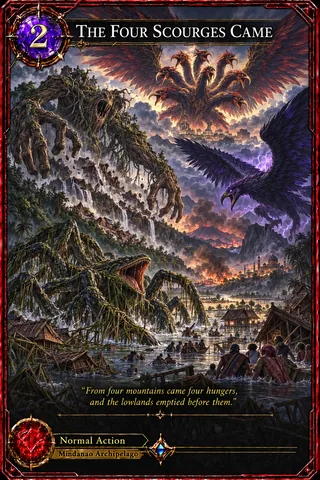
Before the monsters: a Mindanao under water
The story opens with a detail that is easy to read past.
The sea covered the lowlands. All of them. What is now flat farmland was ocean, and the only land above water was mountain - so every village in the story sits on high ground, because high ground was the only ground there was. The people were prospering. Nothing was wrong.
This matters because of how the story ends, and I will come back to it.
Into that world came four creatures. The text does not explain where from. They simply "appeared in the land," and within a short time they had eaten every human being they could find.
The four scourges
They are worth taking one at a time, because the text gives each one a specific territory and a specific horror. These are not four interchangeable monsters.
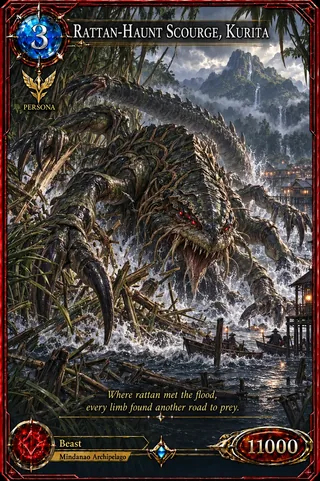
Kurita had many limbs and lived partly on land and partly in the sea. Its haunt was the mountain where the rattan grew. Cole's text does not name that mountain; later tellings call it Kabalalan. It brought, in the text's phrase, "utter destruction on every living thing."
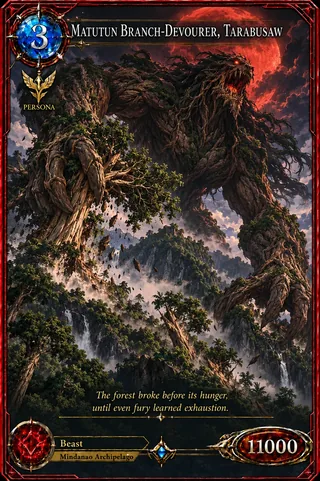
Tarabusaw was shaped like a man, and this is the one I find hardest to shake. Not a beast - an ugly creature in the form of a man, living on Mount Matutun, devouring people "far and wide from that place." A monster shaped like you is a different kind of fear from a monster shaped like an animal.
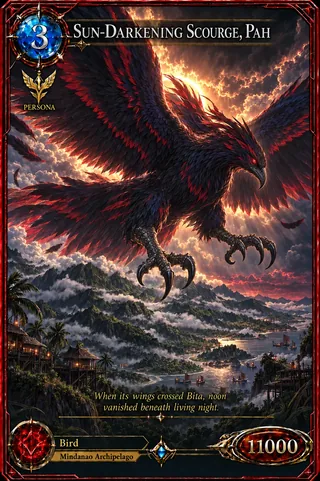
Pah was a bird so large that when it flew it covered the sun and brought darkness to the earth. Its egg was the size of a house. It lived on Mount Bita, and the only survivors in that region were people who hid in mountain caves.
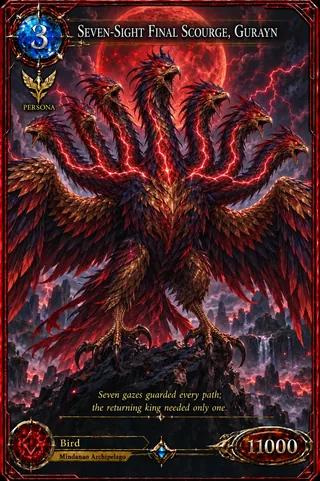
The fourth is the one nobody remembers, and it is arguably the worst. An enormous bird with seven heads and the power to see in every direction at once. Its home was Mount Gurayn. You cannot hide from a thing that sees in all directions. The text gives it no name of its own - it is known by its mountain.
Four creatures, four mountains, and a country emptied of people.
The city beyond the sunset
News of the disaster spread until it reached, in one of the most quietly grand lines in the text, a city "far across the sea in the land of the golden sunset" so great that looking at its many people "would injure the eyes of man."
Its king was Indarapatra. He heard, and he was filled with compassion, and then he did something that reads differently every time I come back to it.
He did not go. He called his brother Sulayman and begged him to go.
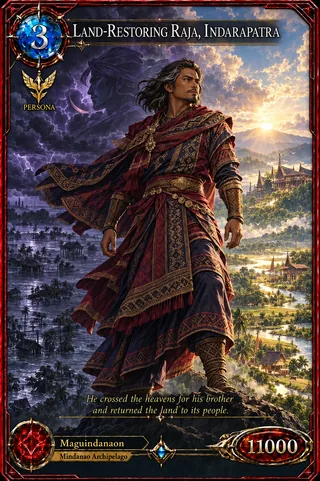
Sulayman agreed immediately. Indarapatra gave him a ring and a sword. And then he planted a young sapling by his window and told him:
By this tree I shall know your fate from the time you depart from here, for if you live, it will live; but if you die, it will die also.
A living thing, planted at a window, whose only job is to report whether a man far away is still breathing. Written down sometime before 1905. I have not found a better image of waiting in any folklore I have read since.
Three victories, and the price of the third
Sulayman did not walk to Mindanao and did not take a boat. He travelled through the air and landed on the mountain where the rattan grew.
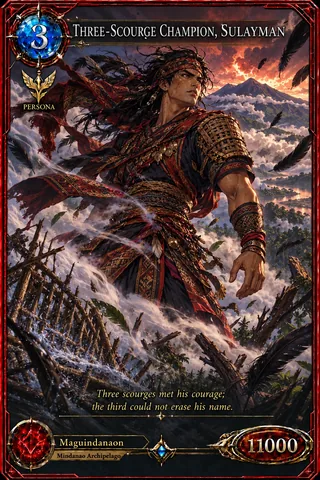
He stood on the summit and looked out at the villages and saw no living thing anywhere, and he cried out - "Alas, how pitiful and dreadful is this devastation!" - and the mountain moved under him, and Kurita came out of the ground and sank its claws into his flesh. He drew the sword his brother gave him and cut it to pieces.
At Mount Matutun, Tarabusaw came out of the trees with a yell. They looked at each other and neither showed fear. The monster said it would devour him; Sulayman said he would kill it. Then Tarabusaw tore whole branches off the trees and used them as weapons, and the fight went on for a long time, until the creature fell exhausted and Sulayman killed it.
Two down. Then Mount Bita.
He walked past house after house and found nobody, and the text says he grew sadder at each moment. Then the light went out - a sudden darkness over the whole land - and he looked up and saw a great bird coming down on him.
He struck. The sword took the wing off, and the bird was dead before it landed.
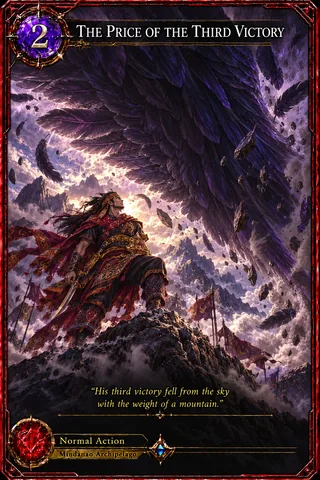
And then the severed wing fell on Sulayman and crushed him.
He won. He killed the third monster with one stroke. And the thing he killed fell on him and killed him, in the same moment, on an empty mountain with nobody alive within miles to see it.
The tree at the window
Far away, Indarapatra was sitting at his window.
He looked out and saw the little tree wither and dry up.
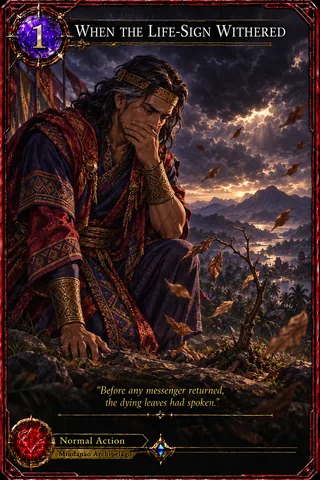
"Alas, my brother is dead," he said, and wept bitterly.
There is no messenger in this story. No survivor staggers home with the news. A man looks out of a window at a plant and learns that his brother is gone, because he built the instrument himself and he knows exactly what it is telling him.
The brother who went second
Indarapatra put on his sword and belt and went to Mindanao himself.
What follows is grief, walked backwards. He comes to the rattan mountain and finds the bones of Kurita - so his brother was here, and won, and moved on. He comes to Matutun and finds the bones of Tarabusaw - here too, and won, and moved on. He is tracking a dead man by the wreckage of his victories.
At Mount Bita he finds the bird dead on the ground, lifts the severed wing, and finds his brother's bones underneath with the sword lying beside them.
He wept for some time. Then he looked up, and there was a small jar of water beside him.
The text's explanation is one clause long: this he knew had been sent from heaven. No god appears. Nothing is negotiated. He poured the water over the bones and Sulayman came back to life.
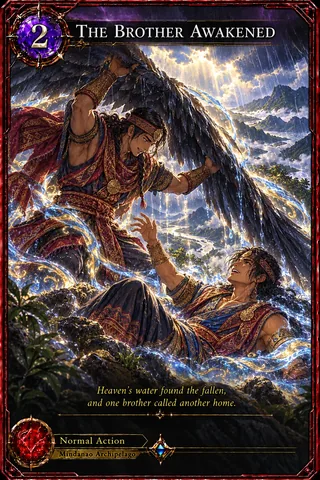
And then the resurrected man says the single strangest line in the story. Sulayman declares that he had not been dead - only asleep.
After that, Sulayman goes home. He does not stay for the fourth monster. He goes home, and the two brothers are happy, and the story lets him leave.
The seventh head, and then the search
Indarapatra went on alone to Mount Gurayn and killed the bird with seven heads. The text spends one sentence on it. The monster that can see in every direction gets less description than the jar of water.
With all four dead, he began searching the country to see whether anyone had survived underground.
He saw a beautiful woman at a distance and hurried toward her, and she vanished through a hole in the ground. Tired and disappointed, he sat down on a rock - and saw beside him a pot of uncooked rice and a fire already burning on the ground in front of it.
He cooked the rice. Someone laughed nearby. He turned and there was an old woman watching him.
The person who actually knew where everyone was
She talked with him while he ate, and she told him the thing he had come to find out.
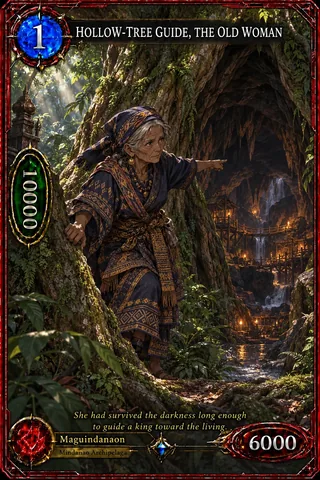
A few people were still alive. They were hidden in a cave in the ground and never came out. She and her husband had survived in a hollow tree, and had not dared leave it until after Sulayman killed Pah.
Then she led him to the cave.
That is how the story resolves. Not by a fifth battle. The two kings kill the monsters, and then an old woman who spent the entire catastrophe inside a tree walks the surviving king to the door and knocks.
Inside were the headman, his family, and his people, who had not yet heard that the monsters were dead. When they understood what had been done for them, the headman gave his daughter to Indarapatra in marriage - and she was the woman he had seen at the mouth of the cave.
The people came out and went home.
And the sea withdrew from the land and gave the lowlands to the people.
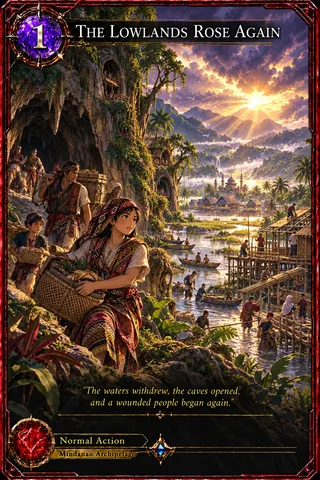
That is the last line, and it is why the opening detail matters. The story does not end with the country restored to what it was. It ends with the country becoming something it had never been. Everyone had always lived on mountains. The reward for surviving is the ground itself - new land, uncovered, that nobody had ever farmed. The monsters emptied Mindanao, and what replaced them was a bigger Mindanao.
Where this story actually comes from
This is the part most retellings skip entirely, and it is the part that decides whether you can trust any of the rest.
The text I have followed here is from Mabel Cook Cole's Philippine Folk Tales (1916), in the section titled "Mythology of Mindanao." Cole's own footnote says it was first recorded by N. M. Saleeby - Najeeb Saleeby, who worked extensively on Moro history and law in the early 1900s. So this is a written record of an oral tradition, taken down by one man and republished by another, in English, over a century ago. That is not the same thing as the tradition itself.
Cole files it under "Moro." That is the term her book uses for the Muslim peoples of Mindanao and Sulu collectively. It is not a synonym for Maguindanao. The tale is generally associated with Maranao and Maguindanao tradition, and related figures turn up across the Darangen epic cycle, but if you want to be accurate about what the 1916 source says, it says Moro and Mindanao. I have tried to keep that distinction rather than tidy it away.
Cole's notes flag two more things worth knowing. The giant birds, she suggests, likely descend from Indian literature and the garuda. And Sulayman is probably Solomon - the Old Testament figure, who became a major heroic presence in Malay romance. This story has Arabia and India inside it as well as Mindanao, and the recorded version is honest about that.
You can read the full text free at Project Gutenberg: Philippine Folk Tales, Mabel Cook Cole.
What a card game is allowed to do with this
I build Codex Legends, a trading card game about Philippine history and folklore, and the Mindanao set follows this story closely enough that its ten story cards are the plot in order: The Four Scourges Came, A Vow Carried by the Wind, Kabalalan Shook From Below, Until Tarabusaw Tired, The Price of the Third Victory, Day Became Night, When the Life-Sign Withered, The Brother Awakened, Seven Heads Before One King, The Lowlands Rose Again.
Two rules I hold myself to, and they are worth stating plainly because the temptation to break them is constant.
Do not invent folklore. If an episode is not in a source, it does not get a card, no matter how good it would look. Where a name comes from a later telling rather than Cole - Kabalalan, for the rattan mountain - that is a research decision, not a discovery, and it should be labelled as one.
Do not let a card become the citation. A card is an interpretation with art on it. The Old Woman is a card in the set because she is in the text; her card art is my invention and the text is not. Those two things must not be allowed to blur, especially when the subject is the living tradition of living communities.
Folklore is a telling, not a historical record. Anything above that sounds like fact is fact about the recorded text, not about the past.
Sources: Mabel Cook Cole, Philippine Folk Tales (Chicago: A. C. McClurg, 1916), "Mythology of Mindanao," recorded originally by N. M. Saleeby. This is a retelling of a recorded oral tradition, not a historical account.
The four scourges, both brothers, the old woman and the cave are all cards in the Mindanao set of Codex Legends. You can play it free in your browser - no download, no account.
Questions people ask about this story
- Is Indarapatra and Sulayman a Maguindanao story or a Maranao story?
- Both traditions carry related material, and the figures appear across Maranao epic literature. Cole's 1916 printing labels it 'Moro' and 'Mythology of Mindanao' rather than naming a single people, and it credits Saleeby as the original recorder. Anyone telling you the attribution is simple is tidying up.
- What are the four monsters called?
- Kurita, the many-limbed creature of the rattan mountain; Tarabusaw, shaped like a man, on Mount Matutun; Pah, the sun-covering bird of Mount Bita; and the seven-headed bird of Mount Gurayn, which the text leaves unnamed.
- Does Sulayman die?
- Yes - crushed by the wing of the bird he had just killed. His brother later revives him by pouring water from a jar 'sent from heaven' over his bones. Sulayman then insists he was only asleep, and goes home before the last monster is dealt with.
- Who actually saves the survivors?
- Indarapatra kills the last monster, but it is an old woman who had hidden in a hollow tree through the whole disaster who tells him people are still alive and leads him to their cave.
- Where can I read the original?
- *Philippine Folk Tales* by Mabel Cook Cole, 1916, is public domain and free at Project Gutenberg. The Mindanao material begins under 'Mythology of Mindanao.'
Mabel Cook Cole, Philippine Folk Tales (1916), 'Mythology of Mindanao', recorded originally by N. M. Saleeby. A retelling of a recorded oral tradition, not a historical account. Read the source.