Insights · Visayas
Bakunawa and the Last Moon: A Visayan Eclipse Story
Imagine being down to the world's last moon—and watching something begin to swallow it. That is the fear at the heart of one recorded Bakunawa story. The response is not a lone warrior's sword: people come together and make noise to save the light. The telling below follows the text attributed to Fernando A. Buyser, reproduced with a Bisaya text and English translation by the Aswang Project.
Seven moons, then one
In this telling, Bathala creates seven moons to illuminate the nights. Bakunawa, an enormous serpent, devours six. Only one remains. Bathala places bamboo on that last moon, accounting within the story for the marks visible on its surface.
When Bakunawa attacks the remaining moon, people shout, beat drums and strike other objects. The threat draws children, adults and elders into the same desperate response. Eventually the serpent releases the moon. Darkness gives way to light, and fear becomes gratitude. These details belong to Buyser's reproduced telling; they should not be silently combined with details from every later adaptation.
Why a serpent would swallow the moon
Bakunawa connects an extraordinary sight in the sky with a being people can describe and confront. The National Commission for Culture and the Arts' Sagisag Kultura describes a sea-dwelling serpent with wings, a red tongue and a vast mouth, associated with swallowing the moon during an eclipse. Its entry also recounts the loss of six moons and the use of noise to protect the survivor. Read the NCCA entry.
This is a mythic explanation of an eclipse. Reading it as folklore means asking how the story expresses fear, action and relief—not treating its serpent as an astronomical cause.
A Visayan story, with regional distinctions
The NCCA entry records a Bisayan expression about the moon being affected by Bakunawa, cited from Alonso de Méntrida's vocabulary. It also discusses the separately named Tagalog Laho, drawing on Francisco de San Antonio's Vocabulario Tagalo. Those references show related ways of describing an eclipse; they do not establish that every Philippine community told one identical story. NCCA, “bakunáwa.”
Buyser's text also contains explicit Christian references, visible in the reproduced pages and translation. That is part of this particular written telling. It should not be erased to make the text look like an untouched account from a single earlier period. See the reproduced text and annotations.
The distinction is simple: a written version is evidence of that version. Its printing date cannot tell us, on its own, when an oral story began.
Seeing the card differently
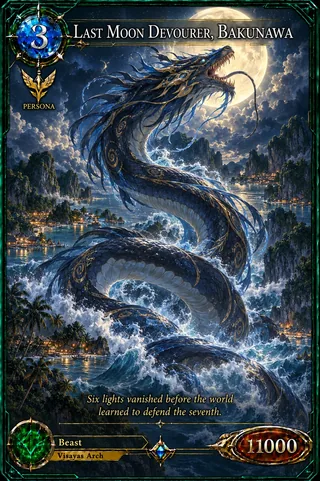
Our card gives Bakunawa a visual form for the game. The story offers another way to look at it: beyond the huge serpent is a shared fear of losing something precious, and a community answering together. That is a reading of this telling, rather than a claim that every storyteller intended the same lesson.
The artwork invites you into the subject. The sources let you look further—and notice where another telling takes a different path.
Questions people ask about this story
- Who is Bakunawa?
- Bakunawa is a serpent associated with eclipses in Visayan traditions. In the seven-moons story discussed here, it swallows six moons and threatens the last.
- Why do people make noise in the story?
- They fear losing the remaining moon. People shout and strike noisy objects as Bakunawa attacks it; the serpent releases the moon, and their fear turns to relief.
- Did the story begin when it was printed?
- A publication date tells us when a particular text appeared in print. It does not, by itself, establish when a story began circulating orally or who invented it.
- Is the card an authentic historical image of Bakunawa?
- No. It is Codex Legends artwork inspired by the figure. The illustration is a creative interpretation; the linked texts supply the evidence for the story.
Story summarized from Fernando A. Buyser's text as reproduced and translated by the Aswang Project; cultural context from the NCCA's Sagisag Kultura entry. This is one recorded telling, not a universal version or a claim about the story's oral origin. Read the source.